01
Drone medical logistics
Zipline, operating first in Rwanda from 2016 and then in Ghana and other markets, flies blood and medical supplies directly to the point of need.
 UBTSInternational Corp.
UBTS Strategic Research Division · 2026 — September update
A continent-wide strategic analysis of the infrastructure gaps that most constrain Africa’s competitiveness, the technology-enabled leapfrog opportunities that can close them, and the strategic response of UBTS International Corp.
01Executive summary
Its population is projected to reach about 2.5 billion by 2050 — roughly one in four people on Earth — with the youngest median age of any continent and the fastest-urbanising cities in the world. The infrastructure needed to turn that demographic weight into economic power remains critically underbuilt.
Closing the gap by copying the twentieth-century playbook — centralised grids, sprawling road networks, brick-and-mortar hospitals, branch banking and concrete-and-steel housing at Western or Chinese scale — is neither financially feasible nor fast enough. The central argument of this report is that Africa should not try.
02The core thesis
Just as mobile telephony leapfrogged fixed lines and mobile money leapfrogged bank branches, the continent can deploy distributed, digital-first and locally manufactured infrastructure that is cheaper, faster and more resilient. The binding constraint — and the highest-leverage investment — is the connectivity, energy and trusted-data layer at the edge.
03What the evidence shows
| Sector | The gap | The leapfrog levers |
|---|---|---|
| Health | A disproportionate share of the global disease burden, a small fraction of the world’s health workforce and financing, and heavy dependence on imported medicines and vaccines. | Drone medical logistics, telemedicine and AI-assisted diagnostics, community-health-worker tools, point-of-care diagnostics, digital surveillance and genomics, local vaccine manufacturing. |
| Agriculture | Low irrigation, minimal fertiliser use, high post-harvest losses and wide yield gaps: a continent rich in arable land that remains a net food importer — and whose quality is rarely measured. | Solar irrigation and cold storage, remote sensing, digital advisory, pay-as-you-go finance, and a scientific data layer that turns measured quality into premium trade. |
| Housing | A deficit in the tens of millions of units, the world’s fastest urban growth, widespread informal settlements and very shallow mortgage markets. | Digital land registries, local low-carbon materials, modular construction, building-level energy and water, and fintech for incremental housing finance. |
04The single most critical gap
Every leapfrog described in this report — telemedicine, digital agronomy, mobile money, digital land title, remote sensing, AI advisory — presupposes affordable broadband and reliable electricity at the edge, and trusted data flowing over them. Without that layer, the other opportunities remain pilots; with it, they scale. This is the layer on which UBTS International Corp. was founded, and it is where the continent’s competitive future is most directly decided.
05Chapter 1 · Why leapfrogging, and why now
Africa’s trajectory is defined by three simultaneous accelerations: population growth, urbanisation and digital adoption. The United Nations projects the continent’s population to roughly double to about 2.5 billion by 2050 (UN DESA, World Population Prospects). This is a demographic dividend only if the workforce is connected to productive infrastructure.
Europe, the United States, China and India each built their economic base on infrastructure paradigms suited to their era. Replicating these at African scale would require capital and time the continent does not have. Leapfrogging is the adoption of an advanced solution that bypasses the intermediate stages other regions passed through. Africa has already produced the two canonical examples:
06Three principles of the African leapfrog model
| Principle | Legacy powerhouse model | African leapfrog model |
|---|---|---|
| Distributed, not centralised | Central plants, grids and hubs feeding outward | Edge-first nodes: mini-grids, point-of-care, on-site production |
| Digital-first | Physical systems, digitised later | Data and connectivity designed in from the start |
| Locally manufactured | Import, or centrally mass-produce | Local and regional production of materials, medicines and hardware |
07Chapter 2 · Public and indigenous health
Health is where infrastructure gaps translate most directly into human cost — and where the leapfrog logic is most vivid.

08Health · indicative comparison
| Dimension (indicative) | Sub-Saharan Africa | China | United States | EU (typical) |
|---|---|---|---|---|
| Physicians per 1,000 people | Often below 0.5 | About 2 | About 2.6 | About 3.5–4 |
| Hospital beds per 1,000 | Often about 1 | About 4–5 | About 2.8 | About 5 |
| Share of medicines imported | Majority | Largely domestic | Mixed | Largely domestic |
| Digital health records | Emerging | Widespread | Widespread | Widespread |
Indicative, directional comparison compiled by UBTS from WHO and World Bank indicators of varying years.
09Health · technology leapfrog opportunities
01
Zipline, operating first in Rwanda from 2016 and then in Ghana and other markets, flies blood and medical supplies directly to the point of need.
02
A single specialist’s expertise, distributed across a wide geography — augmenting clinicians, never replacing them.
03
Smartphone decision support, data capture and referral turn community health workers into a distributed primary-care network.
04
Rugged, portable devices bring testing to the patient and feed results into surveillance systems.
05
Africa CDC, operational since 2017, has advanced continental surveillance and genomic-sequencing capacity.
06
Regional vaccine and medicine production is simultaneously a health-security, industrial and sovereignty objective.
10Inverting the sequence
High-income systems built dense networks of hospitals and laboratories, then digitised them. Africa can build the digital and logistics layer first — surveillance, telemedicine, drones, distributed diagnostics — and add facilities where they bring the most marginal value. Health-data sovereignty, meaning where African health data lives and under whose rules, becomes an infrastructure decision in its own right.
11Chapter 3 · Agriculture
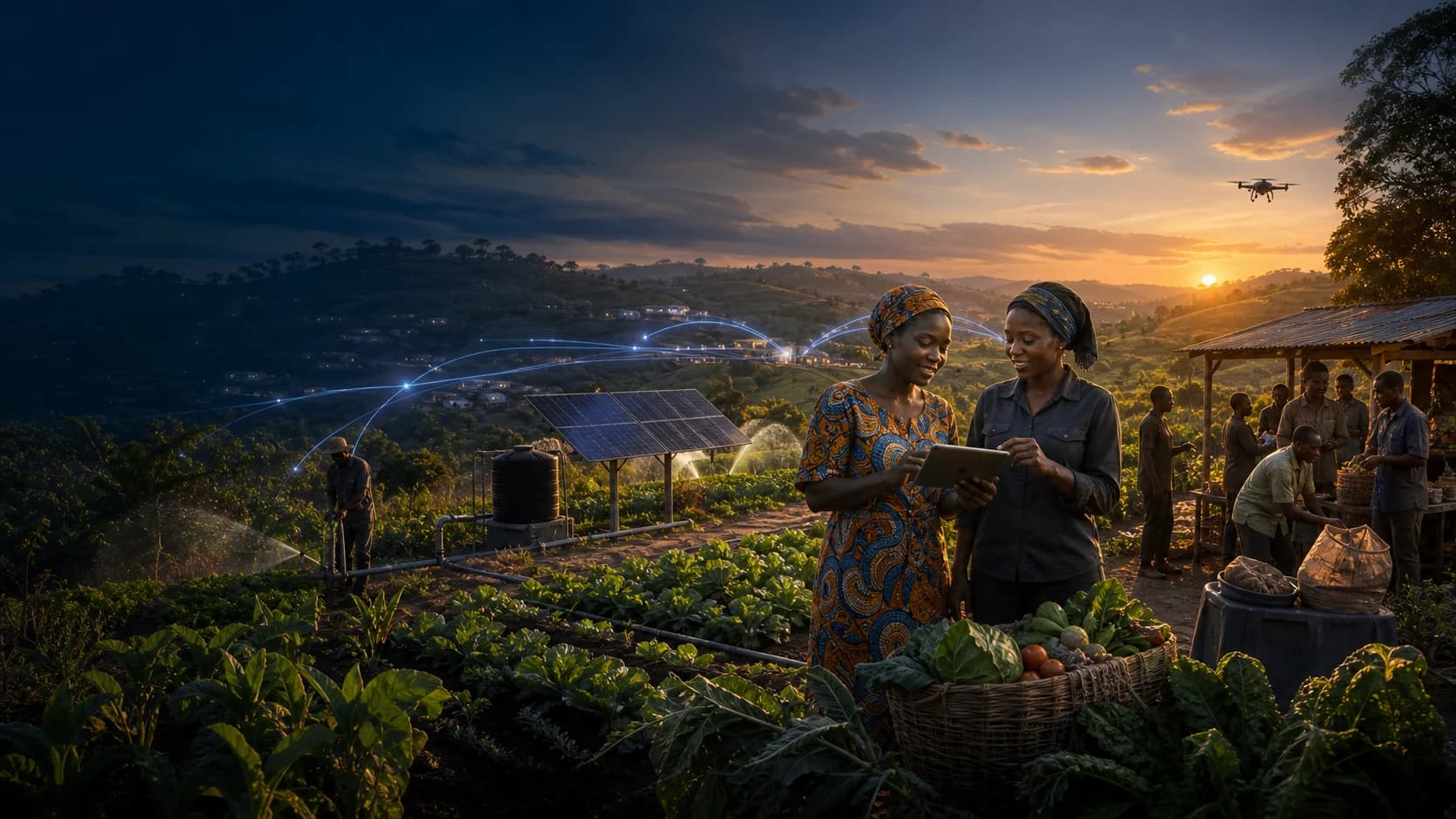
Agriculture is where Africa’s paradox is sharpest: the continent holds a large share of the world’s uncultivated arable land and employs a substantial part of its workforce in farming, yet remains a net importer of food. The infrastructure that turns land and labour into surplus — irrigation, storage, processing, roads, cold chain, market access and knowledge — is the missing link.
12Agriculture · indicative comparison
| Dimension (indicative) | Sub-Saharan Africa | India | China | USA / EU |
|---|---|---|---|---|
| Irrigated share of cropland | Low (single digits %) | High (about 35–40%+) | High | Substantial |
| Fertiliser use per hectare | Very low | High | Very high | High |
| Mechanisation | Very low | Moderate | Rising to high | Very high |
| Post-harvest loss | High | Moderate to high | Lower | Low |
| Cereal yield versus potential | Wide gap | Moderate gap | Narrower gap | Near frontier |
Indicative, directional comparison compiled by UBTS from FAO and World Bank indicators of varying years.
13Agriculture · technology leapfrog opportunities
01
Distributed pumps and cold rooms on pay-as-you-go finance — a double leapfrog past the grid and past mega-canals.
02
Satellite and drone monitoring bring crop-health mapping and yield estimation to millions of small plots.
03
Agronomic advice, weather and prices delivered to farmers’ phones, with direct buyer linkages.
04
Credit, insurance, inputs and equipment-as-a-service without a branch or formal collateral history.
05
Climate-resilient, higher-yielding varieties deployed with agronomic support.
06
Measured quality, attested by accountable professionals and carried to the buyer, turns into premium prices and bankable production histories.
14The data layer is becoming mandatory
| Force | What is happening |
|---|---|
| National traceability systems | Côte d’Ivoire launched a national coffee-cocoa traceability system on 12 June 2026 and made its producer card mandatory on 1 September 2026, with farm geolocation and digital payment. Cameroon’s ONCC renewed a three-year farm-mapping and geospatial-monitoring partnership on 10 September 2026. |
| Market regulation | The EU Deforestation Regulation applies from 30 December 2026 for large and medium operators and from 30 June 2027 for micro and small operators, requiring plot-level geolocation for covered commodities. |
| Corporate climate reporting | The GHG Protocol’s Land Sector and Removals Standard, published on 30 January 2026, takes effect on 1 January 2027; companies reporting land emissions will need farm-level data. |
15From provenance to measured quality
From provenance to measured quality
National systems answer where a crop came from. The next leapfrog answers what it is: soil, crop health, laboratory results and custody for every plot and batch. Premium buyers already trade on those attributes — a roaster on cup score, a miller on aflatoxin levels, a spinner on fibre length. A scientific data layer that measures them at origin and carries them to the buyer converts African quality into African income.
Beyond the Green Revolution path
Asia’s Green Revolution rested on large canals, heavy fertiliser and centralised distribution. Africa’s opportunity is a digitally guided, distributed, solar-powered transformation: precision inputs guided by sensing, solar irrigation instead of mega-canals, mobile knowledge instead of a vast extension bureaucracy, and measured quality instead of anonymous commodity grades.
16Chapter 4 · Housing
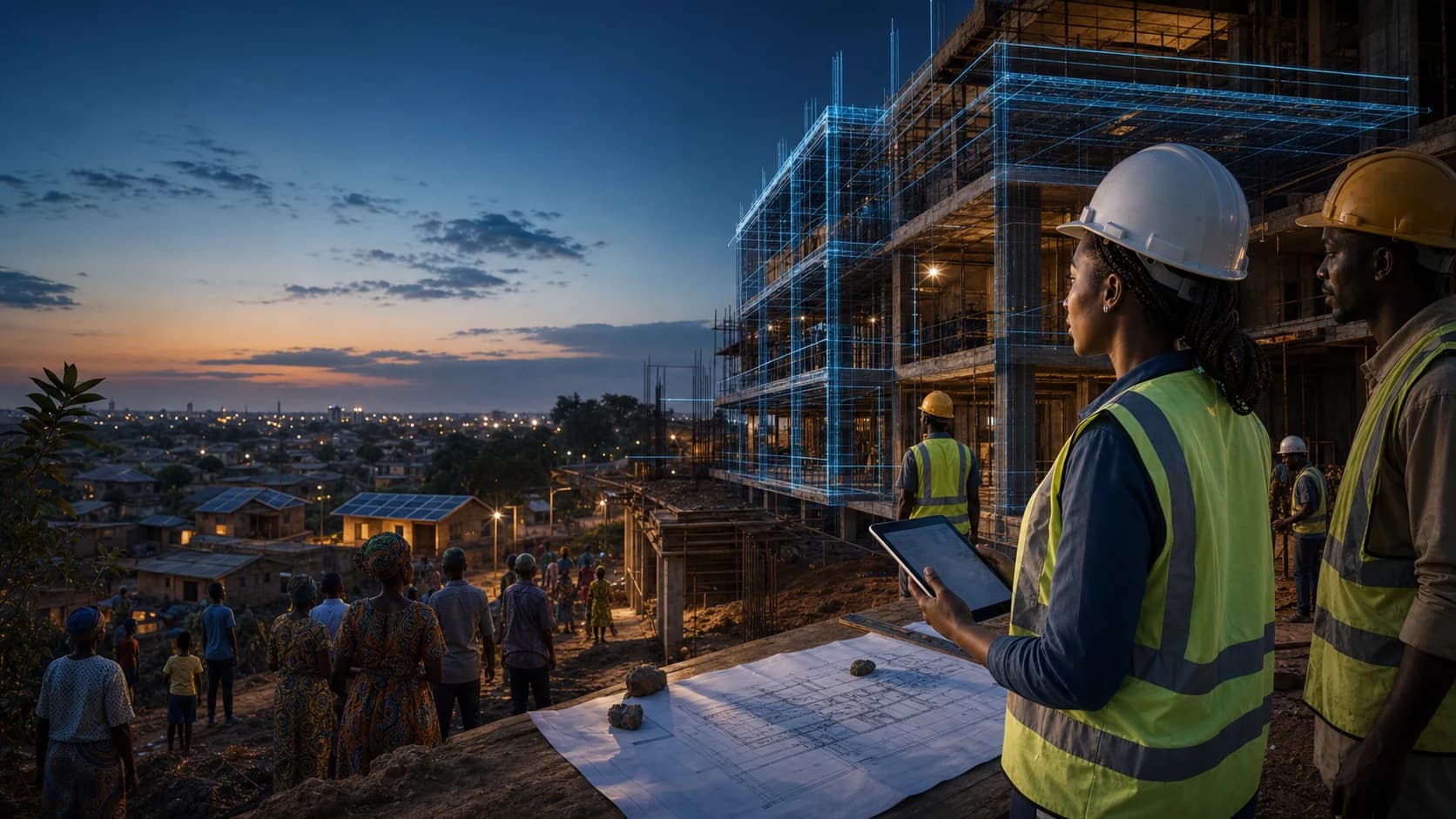
Africa is urbanising faster than any region in history. The digital layer proves decisive through land rights and housing finance.
17Housing · indicative comparison
| Dimension (indicative) | Urban Africa | China | USA / EU |
|---|---|---|---|
| Pace of urban growth | Fastest globally | Rapid, now maturing | Slow or stable |
| Share in informal housing | High | Much reduced | Very low |
| Mortgage market depth | Very shallow | Deep | Deep |
| Land-title digitisation | Early or partial | Advanced | Advanced |
| Dominant building material | Imported, cement-heavy | Domestic cement and steel | Domestic, regulated |
Indicative comparison compiled by UBTS from UN-Habitat and national sources.
18Housing · technology leapfrog opportunities
01
The keystone: secure, verifiable title unlocks finance, investment and municipal planning.
02
Compressed earth blocks, stabilised soil and agricultural-waste materials cut cost and carbon.
03
Faster, standardised delivery where it proves cost-effective at scale.
04
Rooftop solar, storage, rainwater harvesting and on-site sanitation ahead of trunk networks.
05
Rent-to-own and incremental micro-mortgages matched to how people earn and build.
06
Geospatial tools and digital twins let cities plan ahead of growth rather than retrofit.
19Chapter 5 · Cross-cutting enablers
A foundation of connectivity, energy, digital finance, skills, financing and enabling policy.
The foundational layer
Mobile connectivity is widespread, yet a meaningful usage gap persists: many people live within range of mobile broadband but do not use it, because of affordability, device cost, digital skills and relevance of content, as GSMA documents in its connectivity reporting. Investment continues in submarine cables, terrestrial fibre, 4G and 5G, and data-centre capacity.
02
Sub-Saharan Africa accounts for the bulk of the world’s population without electricity access, according to IEA and World Bank tracking. Solar home systems, mini-grids and commercial solar deploy with pay-as-you-go mobile-money finance. Towers and edge nodes need power, and solar-plus-storage increasingly delivers it.
03
Since M-PESA’s launch in 2007, Africa has become a global leader in mobile-money adoption. Mobile money is the rail beneath agricultural finance, housing finance, pay-as-you-go energy and health payments.
04
Making things locally — vaccines, building materials, solar and electronic hardware, agricultural inputs — reduces both cost and vulnerability. The scale of the AfCFTA single market makes regional manufacturing viable.
05
Infrastructure without the people to operate it does not deliver. Africa’s youthful population is the raw advantage; training that is tied directly to employment is what converts it into productive capacity.
06
The African Development Bank’s estimate of an infrastructure financing gap of US$68–108 billion a year frames the challenge. A mini-grid, a tower or a crop value chain is small, fast to deploy and financeable in stages against demonstrated demand.
20Why connectivity is the keystone
A drone network needs data links; a land registry needs to be reachable; a farmer’s advisory needs bandwidth; a quality record needs to travel from the plot to the buyer; mobile money needs the network to exist at all.
21Policy and regional integration
| Framework | Relevance |
|---|---|
| AfCFTA | The African Continental Free Trade Area, trading since 2021, creates the single market that gives regional infrastructure and manufacturing their scale. |
| Smart Africa | A continental initiative to accelerate and harmonise the digital-economy agenda. |
| PIDA | The African Union and AUDA-NEPAD programme for prioritising cross-border infrastructure. |
| Agenda 2063 | The African Union’s long-term development vision, with infrastructure as a central pillar. |
22Chapter 6 · A staged roadmap for the continent
A dollar invested in affordable broadband and distributed power raises the return on telemedicine, digital agronomy, mobile land title, remote sensing and mobile money simultaneously. This is the gap on which the others depend.
| Horizon | Priority focus | Illustrative moves |
|---|---|---|
| Foundation · 0–3 years | Connectivity, energy and trusted-data substrate; digital-finance depth | Affordable broadband and closing the usage gap; solar-plus-storage at edge sites; deeper mobile-money rails; agricultural data layers; digital-ID and land-registry groundwork. |
| Acceleration · 3–7 years | Sector platforms on the substrate | Telemedicine, drone logistics and surveillance at scale; solar irrigation, sensing and advisory; measured-quality premium trade; digitised land title and housing fintech. |
| Competitiveness · 7–10+ years | Integration, industrialisation, sovereignty | Regional integration under AfCFTA; local production of vaccines, materials and hardware; data-sovereign digital public infrastructure. |
23UBTS International Corp.’s strategic response
UBTS was founded at the connectivity layer and earned a first-class telecommunications licence in Cameroon in 2021. The Group has now concentrated its first vertical where the substrate pays most directly: the science of agricultural quality and the trade that pays for it.
Flagship
A scientific protocol of 238 parameters across 12 crops and 8 supply-chain actors, measuring any agricultural product from soil to buyer.
Trade
Ethical and intelligent premium trade on passport-verified quality. UBTS never takes title to goods; the producer never earns less than the baseline at delivery.
Skills
Partnerships with universities and vocational centres, internships along the chain, and a hiring pathway into UBTS.
Finance
Purchase-order finance against passport-verified production, designed to be hosted inside a licensed partner bank.
24Chapter 7 · Conclusion
Africa does not need to retrace the infrastructure history of Europe, the United States, China or India. It has already shown twice — with mobile telephony and mobile money — that it can leapfrog entire stages of development. The same deliberate leapfrog is available in health, agriculture and housing. Each depends on a shared foundation of connectivity, energy and trusted data. That foundation is the single most critical gap, and closing it is the precondition for competitiveness.
25Annex · References and institutional sources
| Institution | Body of work relied upon |
|---|---|
| African Development Bank (AfDB) | Infrastructure financing-gap estimates; Africa Infrastructure Development Index; African Economic Outlook. |
| World Bank | World Development Indicators; sector data on health, agriculture, energy access, water, sanitation and urbanisation. |
| World Health Organization (WHO) | Global Health Observatory; Global Health Workforce statistics and density thresholds. |
| Africa CDC and African Union | Continental surveillance, genomic sequencing and local manufacturing ambitions. |
| FAO | AQUASTAT; crop production, yields, fertiliser use, mechanisation and post-harvest loss. |
| UN-Habitat | Urbanisation, housing deficit, informal settlements and urban services. |
| UN DESA | World Population Prospects: population and urbanisation projections. |
| GSMA | The Mobile Economy; State of Mobile Internet Connectivity; State of the Industry Report on Mobile Money. |
| ITU and IEA | ICT indicators; electricity-access tracking and Africa Energy Outlook. |
| GHG Protocol | Land Sector and Removals Standard (published 30 January 2026; effective 1 January 2027). |
| European Commission | EU Deforestation Regulation application dates (30 December 2026 and 30 June 2027), as confirmed by the Commission’s review of 4 May 2026. |
| AIP and KOACI (Côte d’Ivoire) | Launch of the national coffee-cocoa traceability system (12 June 2026) and mandatory producer card (1 September 2026). |
| Investir au Cameroun | Renewal of the ONCC farm-mapping partnership (10 September 2026). |
| African Union frameworks | Agenda 2063; PIDA via AUDA-NEPAD; AfCFTA; Smart Africa. |
| Company references | Zipline (medical drone logistics, Rwanda from 2016 and Ghana); Safaricom M-PESA (Kenya, from 2007). |
Prepared and authored by UBTS International Corp. Strategic Research Division.
↗Build it with us
The right conversation now is about the protocol, the launch sequence, and the evidence that will prove premium demand crop by crop. We welcome governments and regulators, premium buyers, academic partners, investors and communities.